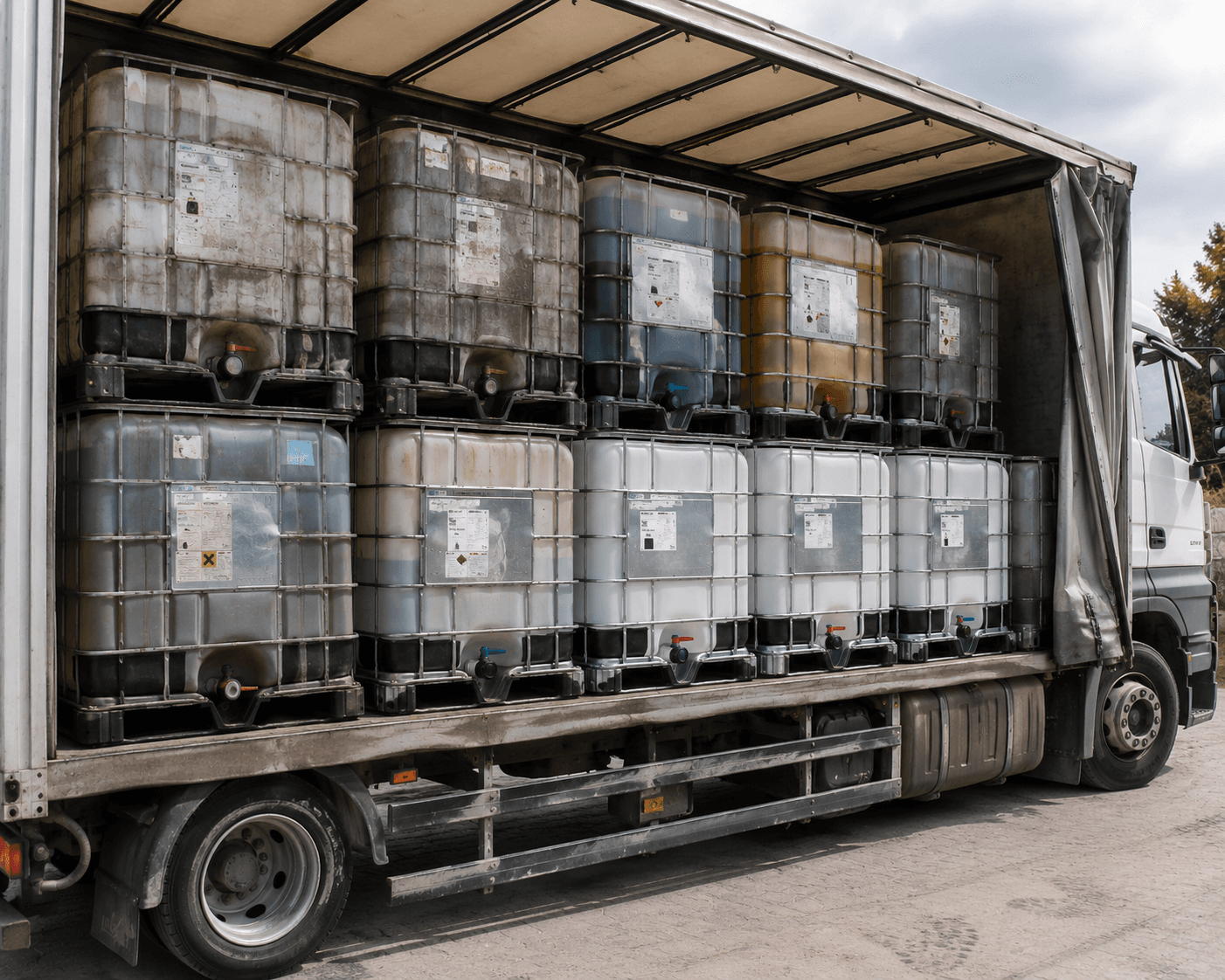
Our zero-landfill commitment.
Since 2021, no corrugate handled at our Oak Creek yard has been sent to a landfill. Not the wet bales. Not the contaminated 4-walls. Not the off-spec pulp grade. Anything we can't put back into circulation goes to a Wisconsin paper-mill recycler we vetted ourselves. We'd rather break even on a load than break the promise.
What we actually measure.
We don't love "eco-friendly" as a word. It means almost nothing. Here's what we track and what we'll share with any customer who asks:
- Inbound load grades. Total weight in, broken down by reuse-eligible vs recycle-only.
- Reuse rate. Of what came in, what percentage shipped back out as a box (not as pulp).
- Avoided virgin fiber. Pounds of new linerboard your reuse replaced.
- CO₂ delta. Manufacturing carbon spared, calculated against the EPA WARM model.
- Diversion. Pounds of corrugate that did not enter a landfill stream because of us.
The life-cycle short story.
Making a new corrugated Gaylord box is roughly six steps: harvest virgin pulpwood, transport to mill, pulp and bleach, dry into rolls, convert into corrugate, ship to converter. Each step is its own little carbon, water, and energy story.
Reusing a box short-circuits steps one through five. You spend a small amount of fuel to transport and a tiny amount of labor to inspect. That's it. The first box bought the embodied carbon. Every subsequent trip is essentially free, environmentally.
The greenest box is the one you didn't have to make.
What we won't do.
- We don't do offsets. Carbon credits are not what our customers buy.
- We don't green-wash bad inventory. If a box is unsafe for a second trip, we recycle it. End of story.
- We don't make sustainability claims we can't hand you the spreadsheet for.
Closed-loop programs, briefly.
The single highest-impact thing we do is set up recurring reverse-flow contracts with shippers and receivers. Your packaging leaves, comes back, gets graded, and ships again. We measure each cycle. Most programs hit a reuse rate above 85% within the first three months. A few are pushing 94%.
If your sustainability report needs a row that reads "corrugate reused N times via partner program," this is how you get one.
The methodology, fully written out.
For any customer who wants the long version of how we measure impact, here is the methodology in full. We are happy to have an auditor walk through it on request.
Boundary conditions
- We measure impact from yard intake (the moment a box arrives at our dock) to outbound shipment for reuse, or to mill delivery for repulping.
- We do not claim credit for downstream user emissions (the customer's shipping leg).
- We do not claim credit for upstream manufacturing avoidance more than once per box. Each reuse cycle counts once, not cumulatively against a single virgin-production baseline.
- We discount our own operational footprint — inspection labor, electricity, water, return freight — from the gross avoided-impact number for closed-loop programs.
Emission factors used
- Source-reduction CO₂ avoided per ton of corrugate: ~3.1 metric tons CO₂-eq (EPA WARM, most recent revision).
- Recycled-fiber vs virgin-fiber CO₂ delta: ~1.4 metric tons CO₂-eq per ton (American Forest & Paper Association LCA summary).
- Round-trip transport CO₂: ~0.03 lbs CO₂ per lb-mile (Argonne National Lab GREET, freight averages).
- Reconditioning energy per box: ~0.4 kWh, converted at the regional electricity-grid CO₂ factor for southeast Wisconsin.
Reuse rate calculation
Inbound corrugate tonnage is weighed at intake. Outbound reused tonnage is calculated from the number of regrade-cleared boxes shipped, multiplied by average per-box weight by class. The reuse rate is outbound-reused over total-inbound. Any inbound that went to repulping counts as "not reused" even if it carried real environmental benefit.
What we round
For headline marketing numbers, we round CO₂ figures down by 5–10% to leave room for measurement error. For customer-specific reporting, we publish the unrounded calculation with the full worksheet attached. The discrepancy you see between the website's "~11.4 lbs per box" and a customer report's "10.7 lbs per box" is this rounding convention, not a methodology change.
Materials we don't handle, and where to take them.
Being honest about scope is the other half of a sustainability claim. Here is what we will not handle, and where we point customers instead.
| Material | Why we decline | Where to take it |
|---|---|---|
| Wax-coated corrugate | Mill recycling capacity gone (2025) | Regional waste-to-energy partners |
| Class 4–9 hazmat residue containers | Licensing & cross-contamination risk | Two RCRA-permitted partners we'll refer |
| Wet / contaminated medical packaging | Regulatory; chain-of-custody risk | Medical-waste specialty handlers |
| Food-soiled corrugate (visibly contaminated) | Mill rejects | Composting where available, otherwise WTE |
| Lithium-battery-adjacent packaging | Fire risk in baling | Specialty battery recyclers |
The third-party angle.
We are not certified under any specific sustainability scheme — no B Corp, no SBTi, no CDP. We've looked at each. The certifications that fit our scope are expensive and add operational overhead we'd rather spend on the actual work. The ones that are affordable are either too narrow or too broad to be meaningful for a single-yard operation.
What we will do: send any customer the unfettered data file behind our annual rollup. Walk a third-party auditor through our regrade station and our recycling-stream documentation. Share the worksheet behind every CO₂ claim on the website. If you need a certification number for procurement compliance, we are probably not your vendor. If you need defensible, auditable impact data, we are.
A pragmatic note
We are a business. We make money when reused boxes outsell new ones. The reason our model works is that the economics and the ecology happen to point in exactly the same direction here. We're not pretending otherwise — and we think that's the strongest possible case for the work.